Wonderwerk Cave

  • Wonderwerk Cave
  • https://museumsnc.co.za/new_site/wp-content/uploads/2021/05/Wonderwerk-voiceover.jpg
  • ALL CATEGORIES
  • https://museumsnc.co.za/new_site/wp-content/uploads/2021/Wonderwerk-Cave-Voiceover.mp3

Wonderwerk means Miracle. It is an apt name for a cave which is not only an extraordinary place to experience but is also unique in its geological, archaeological and historical aspects.

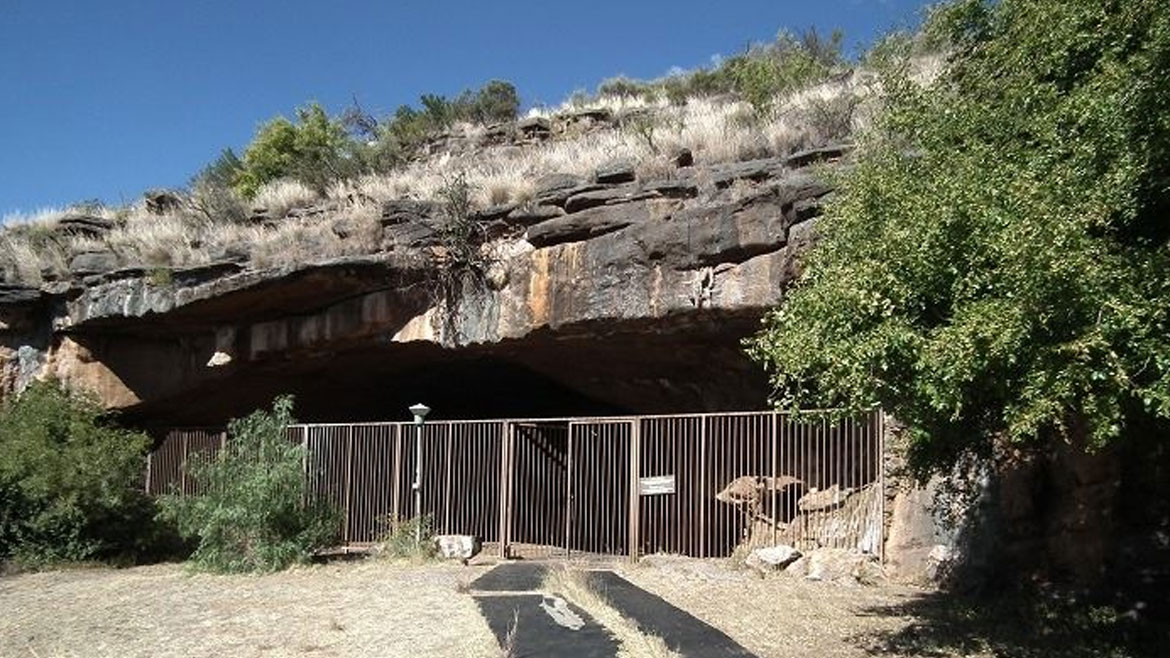
Before entering the cave, look at the rocks of the Kuruman Hills. The cave is in dolomite rock that underlies the Banded Ironstone Formation. The dolomite formed in a shallow ocean over 2 billion years ago. The rock contains stromatolites, some of the earliest traces of life on earth. Tube-like solution cavities such as this then formed underground in the dolomite rock, which is soluble. In this instance it has been opened at one end by erosion over millions of years.

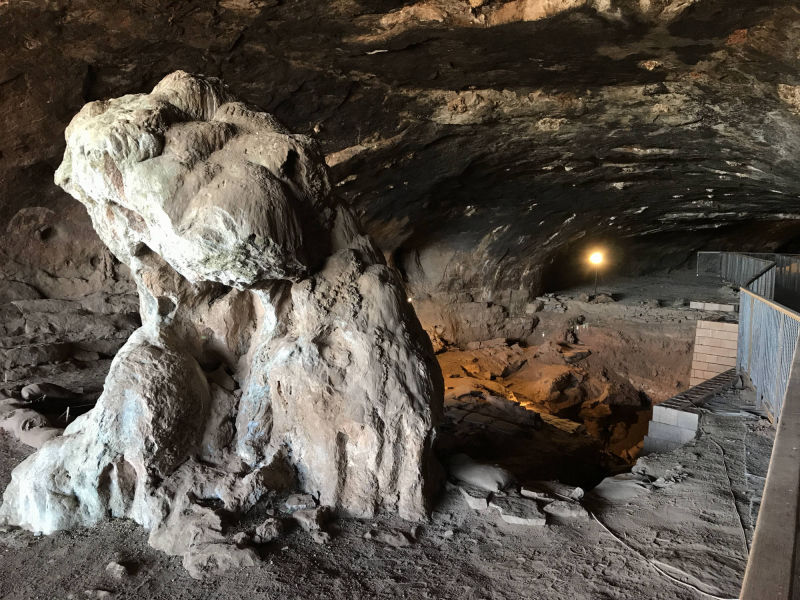
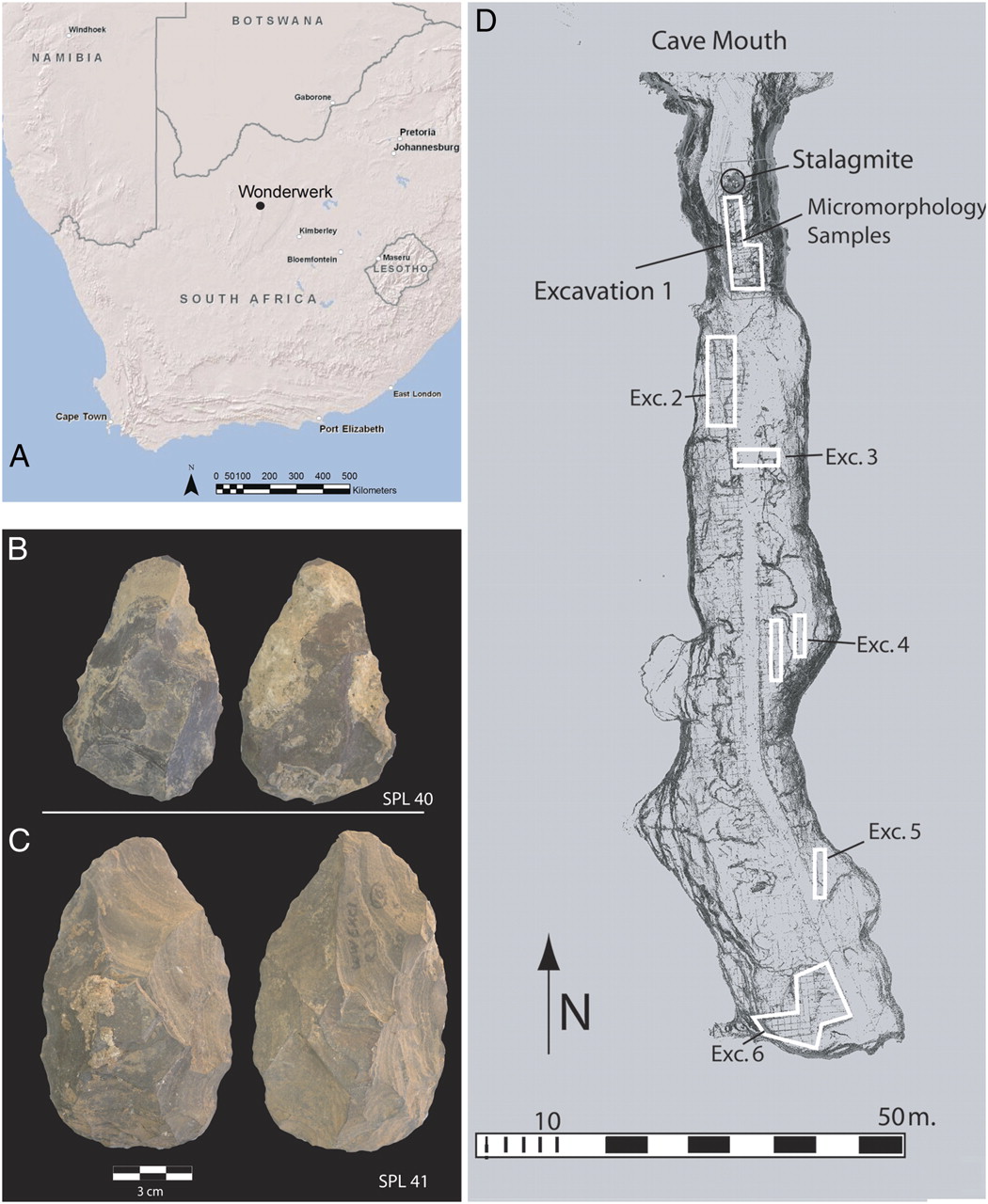
When you enter the cave almost the first thing you see is a massive stalagmite which has formed from water dripping through the dolomite above, depositing calcium carbonate. This stalagmite began to grow about 35 000 years ago and is still growing today.
On the walls near the front of the cave are rock paintings of animals and geometric signs, made by hunter-gatherers who lived in the cave until the 1800’s. These are referred to as finger paintings. Amongst the images are some finely outlined and hard-to-see paintings of eland and other animals which are believed to be possibly older than the finger paintings.

In the deep archaeological excavations behind the stalagmite you can see the layered deposit which stretches from the recent past, at the top of the sequence, to almost two million years back, at the base of the excavation. Stone tools are found throughout, and there is also good preservation of animal bone and plant remains. While human occupation was not continuous, the sequence provides unique insights into key episodes in the deep human story represented in this cave. The Oldowan artefacts found in the basal layer make Wonderwerk Cave the earliest known cave dwelling of human ancestors. All other sites of that time period were open-air occurrences – where early humans dwelt out in the open.

Further up the sequence, in a layer dated to around one million years ago, traces of wood, ash, and evidence of burning on bone and stone, are evidence of fire, and the oldest known indication that our early ancestors at that time used fire. Early human use of fire, for defence, for light and warmth, and, most significantly for cooking, is argued to have been a driving force behind key aspects of human evolution. Cooked foods were more easily digested, leading to changes in early human digestive anatomy, as well as changes in teeth, jaw size and shape of face.

The recent publication of results of magnetostratigraphy and cosmogenic dating at Wonderwerk Cave confirm the timing of these milestone developments in early human history here.

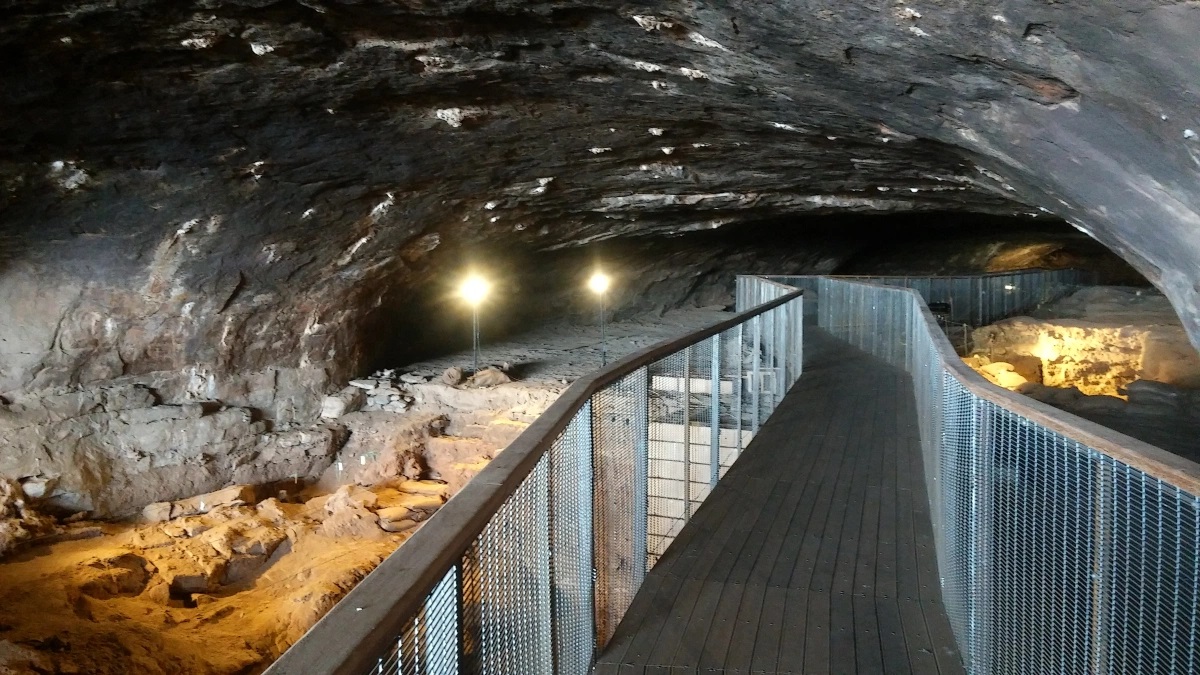
A walkway will guide you beyond this first excavation, to the back of the cave, a 140 metres from the cave entrance. Archaeological investigations there show that human ancestors used the dark innermost reach of the cave some 500 thousand years ago. We do not know why they would make this long trek into the mountain, but we do know that they left crystals and red ochre there, along with stone tools and animal bones. Might these be elements of symbolic behaviour, emerging long before the dispersal of modern humans out of Africa?

Humans are not the only creatures that have used the cave. Owls have perched at certain spots inside the cave over many thousands of years, dropping their pellets onto the accumulating deposit below. Pellets are the undigested and regurgitated parts of a bird’s food, and in the case of owls contain the bones of their prey, such as mice and other small mammals. Because smaller animals are particularly sensitive to changing environments, the accumulated layers of tiny bones beneath the owls’ perches, differing in species mix from layer to layer up through time, provide a way for archaeozoologists to track past changes in climate. Further clues to past environments at Wonderwerk Cave are obtained from pollen preserved in the sediments, isotopic analysis based on ostrich eggshell pieces, identification of vegetation types from charcoal, and from phytoliths, which are microscopic silica structures that form in plant tissues, and survive long after the plants themselves have otherwise decayed or been burnt.

The exceptional preservation of archaeological and palaeo-environmental remains at Wonderwerk Cave makes it one of the most important known sites – the more remarkable for its long sequences of occupation. Archaeological investigation started in the middle of the twentieth century. A programme of systematic excavation, dating, and a range of analyses began in the late 1970s, including the work of Peter Beaumont of the McGregor Museum and of Francis Thackeray and Anne Thackeray. From 2004 the current Wonderwerk Cave Research Project has evolved as an international collaboration directed by Michael Chazan and Liora Horwitz, bringing together a team of more than two dozen specialists, both local and from other continents, to gain a better understanding of this spectacular site and its regional context.

Wonderwerk Cave was declared as a heritage site in 1993, becoming a grade 1 national heritage site in 2010, and it is managed as a satellite of the McGregor Museum. As important as the research here are efforts to promote public heritage outreach, including work with local communities. As you enjoy your visit here, please help us to preserve this and other heritage sites in the Northern Cape.

Walk through the cave