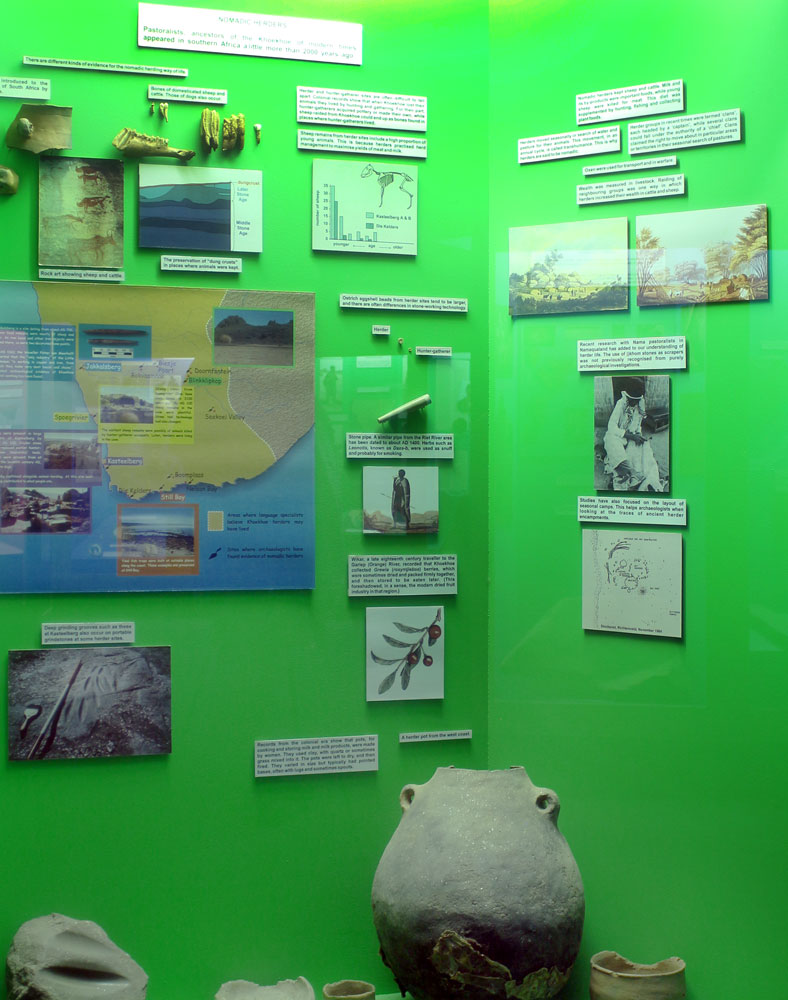
Herder and hunter-gatherer sites are often difficult to tell apart. Colonial records show that when Khoikhoi lost their animals they lived by hunting and gathering. For their part, hunter-gatherers acquired pottery or made their own; while sheep raided from Khoikhoi could end up as bones found in places where hunter-gatherers lived.
Sheep remains from herder sites include a high proportion of young animals. This is because herders practised herd management to maximise yields of meat and milk. This diet was supplemented by hunting, fishing and collecting plant foods. Wikar, a late eighteenth century traveller to the Gariep or Orange River, recorded that Khoikhoi collected Grewia or rosyntjiebos berries, which were sometimes dried and packed firmly together, and then stored to be eaten later. (This foreshadowed, in a sense, the modern dried fruit industry in that region). Nomadic herders also kept cattle – oxen were used for transport and in warfare. Wealth was measured in livestock. Raiding of neighbouring groups was one way in which herders increased their wealth in cattle and sheep.
The seasonal search for water and pasture – in an annual cycle – is called transhumance. Herder groups in recent times were termed ‘clans’, each headed by a ‘captain’, while several clans could fall under the authority of a ‘chief’. Clans claimed the right to move about in particular areas or territories in their seasonal search of pastures.